Cloud-edge CNC feeding — trajectory prediction & dual-end control vs. rotary-spread tornado-series effects
University–industry project: suppress tornado-effect rotary spreading via simulation-based corpus build, embedded trajectory prediction with feedforward CNC, and local software plus Web remote co-control.

Dec 2024——Aug 2025
Background
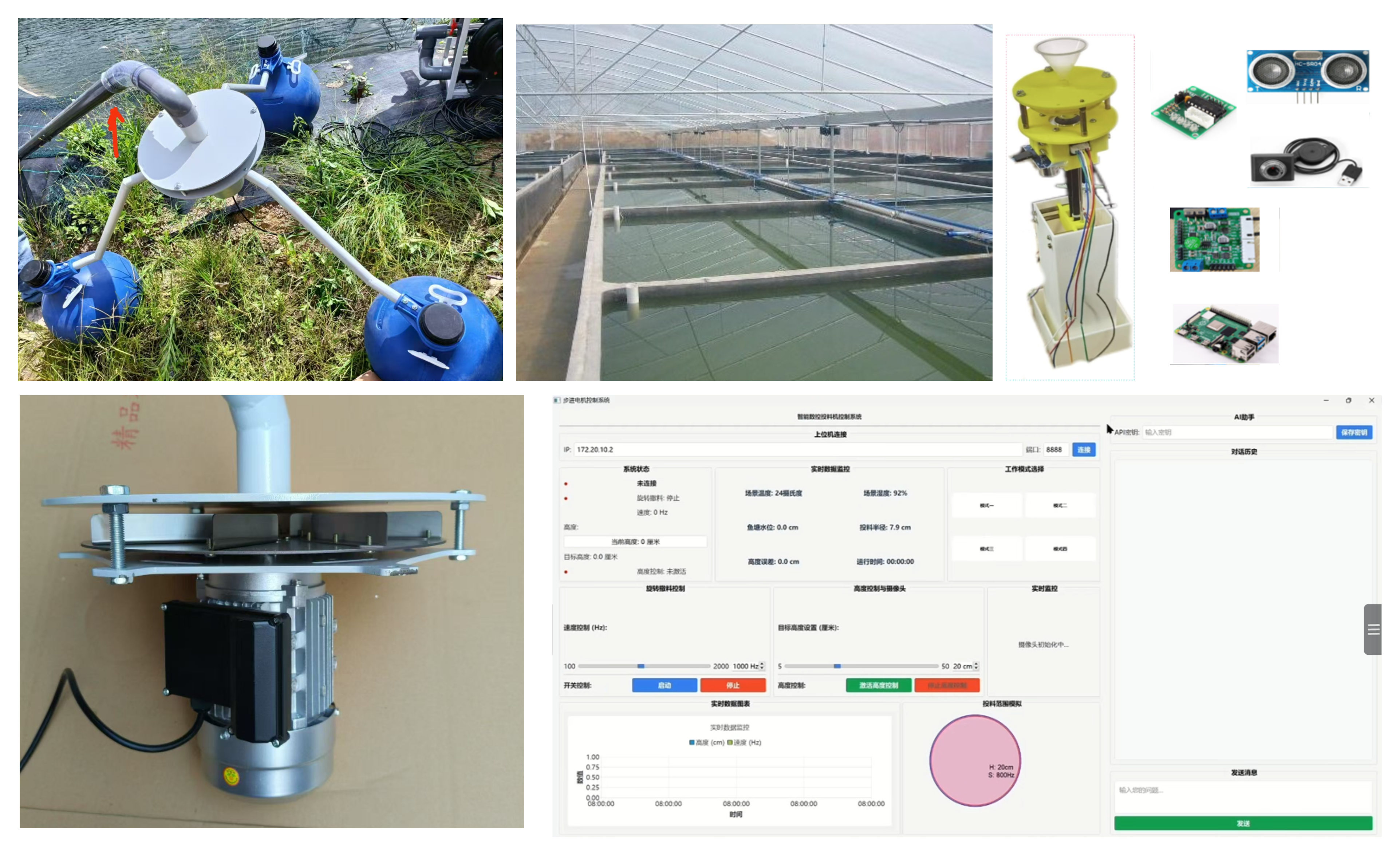
A university–industry collaboration between Fuzhou University and Zhangzhou Tianxiang Household Appliances targets tornado-series effects in large-scale rotary pond feeding: when spin trays couple with airflow and the water surface, pellets enter vortex-like discharge patterns—spiral dense landing bands while outer and deeper zones stay under-fed—while entrainment and trajectory bias can throw fines onto overhead plastic film, cutting effective delivery, adding scrape work, and worsening uneven intake, wasted feed, and local water-quality swings. The partner sought to keep the existing mechanical backbone while landing CNC-style feeding ends and smart control for visibility, tuning, and traceability at the pond edge. Development surveyed multi-condition sites and built pellet-dynamics simulation with batch trajectory datasets, trained a landing-point predictor, INT8-quantized and embedded it with feedforward CNC compensation to correct launch parameters in the field—reducing side-throws and film adhesion and improving pond-wide uniformity—while local touch and Web remote consoles with access policies and status supervision formed an IIoT-style closed loop validated in partner field trials.
- For tornado-series rotary spreading—spiral dense bands, under-fed outer zones, and pellets sticking to overhead film—the team surveyed multi-condition pond sites, built a pellet-dynamics simulation, and batch-collected a trajectory dataset in simulation (~12k condition–landing pairs across tray RPM, gate opening, wind, and feed grades, with automatic condition–landing labels).
- For landing bias under RPM–wind coupling and open-loop control that could not curb side-throws or film adhesion, a dual-layer BiGRU encodes short pre-discharge sensor sequences to regress horizontal range and lateral offset; validation landing RMSE fell from ~11.6 cm (physics-only feedforward) to 4.8 cm (R²≈0.91), with INT8-quantized embedded inference under 35 ms per shot. Feedforward CNC compensation cut side-throws ~38% and film adhesion ~42% in field trials, lowering landing-point CV and improving pond-wide uniformity.
- Remote O&M required secured Web control with local touch fallback. Dual local/Web consoles with access policies, parameter push, and status supervision formed an IIoT-style terminal loop validated in trials with Zhangzhou Tianxiang.
Stack
Python, PyTorch, Embedded C, Web dashboard, MQTT-friendly buses