Physics-aware & SHAP-guided adaptive PV power forecasting
DKASC PV forecasting: physics-informed losses, SHAP + TPE tuning, SimpleADWIN drift adaptation; produced an IEEE SMC conference paper.

Fuzhou University College of Electrical Engineering and Automation
Jan 2025——Jul 2025
Background
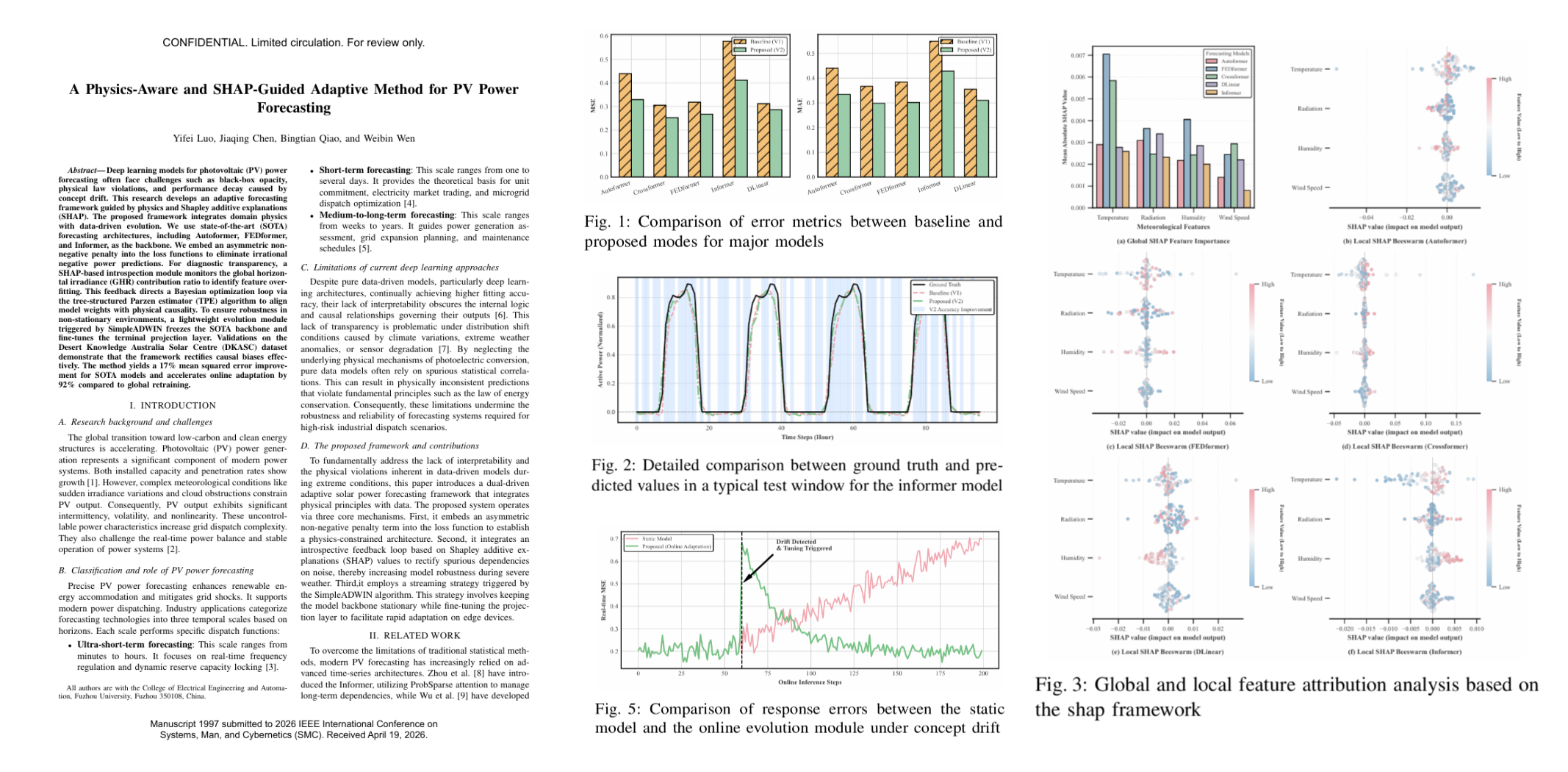
Accurate photovoltaic (PV) power forecasting underpins grid scheduling and plant O&M, yet purely data-driven deep models are often opaque, can violate physics (e.g., irrational negative power), and decay under concept drift—especially on public irradiance–power streams such as DKASC in non-stationary regimes, where SOTA time-series backbones must still absorb domain physics and interpretable diagnostics in training and online updates. This project builds a framework around physics priors, SHAP attribution, and adaptive evolution: asymmetric non-negative losses on Autoformer, FEDformer, and Informer suppress negative power predictions; SHAP monitors contribution shifts for global horizontal irradiance to diagnose overfitting and steer TPE Bayesian hyperparameter search toward physically plausible regimes; when SimpleADWIN detects drift, the backbone is frozen and the terminal projection is fine-tuned, shortening online adaptation versus full retraining. Experiments on the Desert Knowledge Australia Solar Centre (DKASC) support reported MSE gains and faster online adaptation, forming a submission to IEEE SMC 2026.
- For unphysical negative power on non-stationary DKASC streams, asymmetric non-negative penalties were embedded in Autoformer, FEDformer, and Informer backbones with ablations; negatives fell sharply, baseline MSE improved, and SOTA models gained ~17% mean MSE reduction.
- For black-box GHI overfitting and costly seasonal drift, SHAP contribution monitoring was coupled to TPE Bayesian search, and SimpleADWIN triggers freeze backbones while fine-tuning terminal projections—~92% faster online adaptation than full retraining—in an integrated physics–explanation–evolution framework.
Research outputs
Stack
Python, PyTorch, SHAP, Bayesian optimization (TPE), SimpleADWIN